

Readers often ask how to gain more intellectual growth from each book they read.
They want to read more deeply, remember the key ideas, and perhaps even generate their own unique insights into the topic, using the book as a springboard for reverie.
They’re confused, though.
They’re already reading carefully. They pause to reflect on a thought-provoking sentence. Maybe they even take notes.
So why, a week later, when somebody asks them what a book is about, do they freeze? Why do they utter some vague response like “Politics” or “the French Revolution!”.
Despite spending hours in studious reading, they give an answer that anybody who read the title could’ve given.
This is highly demotivating.
Even if a book changes you in imperceptible ways (which it does), and is fun to read, almost nobody wants to spend 20 hours reading a classic novel, Plato’s Republic, or the latest psychology book without anything to show for it.
This used to happen to me all the time in my self-education.
It still happens!
Just the other week, my friend asked me about the novel The Cider House Rules. My mind searched for something clear and original to say, but all it could muster was, “It’s about abortion!”
What an odd book to take on a weekend trip, my friend must’ve thought…
Today, if he asked me about the book, what I think of it, or what its core message is, I would have a far more sophisticated response.
Why?
The reason is simple.
I did more than just read the book carefully.
I took five minutes to write about it.
And I don’t mean copying quotes into a commonplace book (although I do that too).
I mean writing my own feelings and thoughts about what the author has written.
That’s where the real magic happens, where you invite the author into your psyche, dine with them, and leave forever changed.
The top 4 benefits of writing about what you read
A few months ago, I made a commitment to write about every book I read.
And it is by far the best learning technique I’ve added to my self-education in the past year.
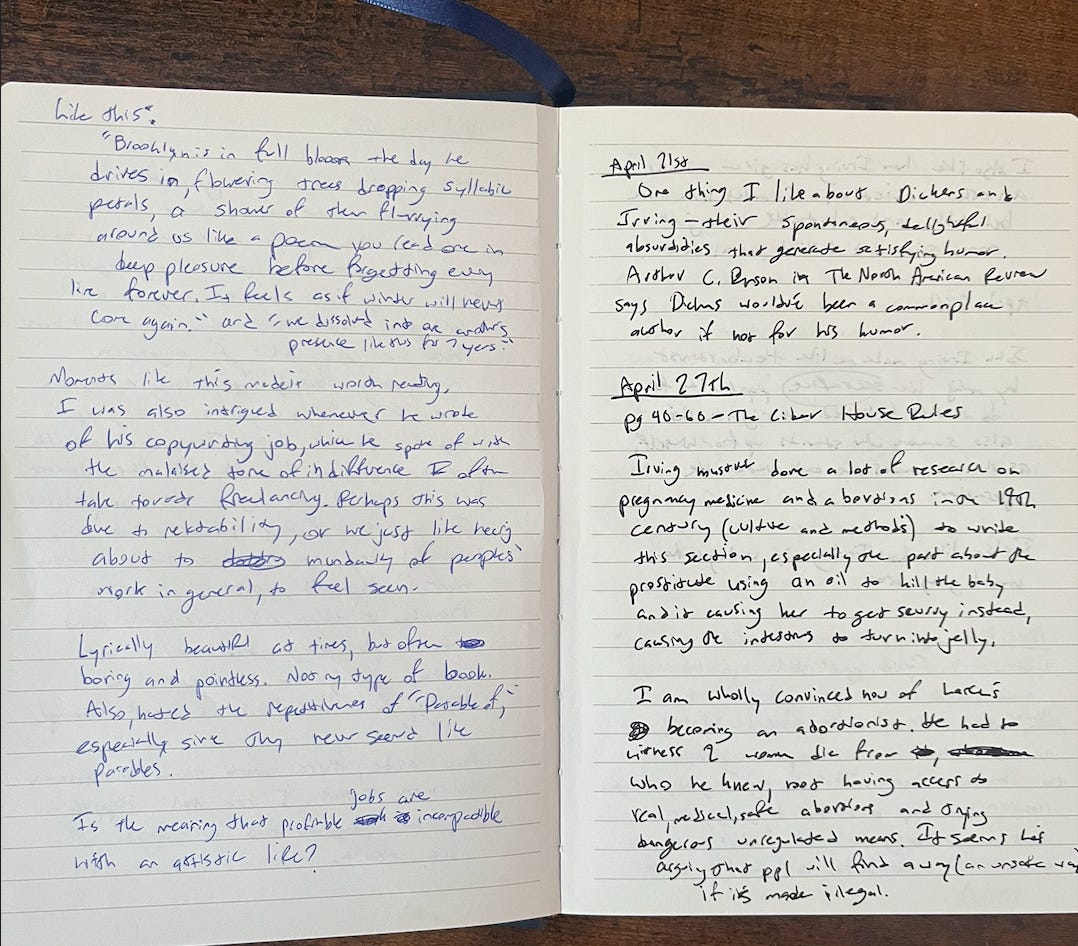
My practice is two phases (I go deeper into my system in this article):
While reading—in spurts—in a private reading journal, where I record my raw and honest impressions, feelings, opinions, likes, and dislikes. It’s amazing to see, in real-time, how much a book is impacting me intellectually or emotionally.
After reading, in a book review, published on Knowledge Lust, where I synthesize my journal entries or take one entry I’m most passionate about and expand on it. Here’s my July roundup of reviews.
This simple 2-part maneuver turns reading from consumption into a two-way conversation, where I hold a discussion with the author, sharing my thoughts and reactions or relating the book to my life or knowledge base.
Here are four benefits I’ve gotten from this practice:
1. You remember more of what you read
I’ve noticed that, when in conversation or a writing session, the books I’ve written about are much more accessible to me.
This is because, in addition to being a solid check on comprehension, writing also forces you to think deeply about the material.
And, according to Harvard’s research, what you think about, you remember.
When you write, you must retrieve key points and scenes from memory, and then reconstruct them in your own words.
And if you are connecting your reading to something you already know, or to your own life, this just increases the chance it sticks.
For example, I’m probably never going to forget that nostalgic moment in My Antonia where the protagonist visits her childhood home and friends, because I connected it in writing to my own recent homecoming.
To sum it up, when you write, you are doing three memory techniques at once: retrieval practice, summarization, and connection-making.
2. Writing leads to original thinking
Often, I don’t know what I think of a book until I write about it.
My reading journal is a place to react honestly to what I’m reading:
To connect an idea to my own life,
To share a feeling
To interrogate an author’s creative decision
To interpret a scene
To riff on the author’s philosophical argument
To say “I love x because y!”
In my book review process, I take the juiciest off-the-cuff impressions and, through expansion, rewriting, and additional research, turn them into clear, informed opinions that will stick in my mind.
The thing that’s most surprising to me is how little I am able to plan the book review.
I have a few notes from my journal, a few half-baked ideas, a general idea of the direction I’ll take. But then, when I start writing, stuff I didn’t anticipate floods out.
This is proof, again, that I don’t know what I truly got from an experience until I write about it.
Writing turns the knob. Retained knowledge and sharp opinions slip out.
You look at it all on the page and think, “Wow, so that’s what I got from this book? I learned a lot. Who knew!” And this can be highly motivating as an autodidact. It’s proof the reading paid off.
3. You have a track record of your reading life
I love flipping through my reading journal to quickly remind myself of a book’s key points, as well as the experience I had while reading it.
In the front flap of the journal, I write down the titles of the books I’ve read, and give them a number from 1 to 10. (which I always end up lowering weeks later after the initial excitement has worn off)
It’s motivating to see the list grow, and to know which books I loved so I can more easily find other books I love. It’s like a picture of my developing taste.
4. Write more, and you end up reading more
This is the biggest benefit I’ve noticed.
Ever since I committed to writing about books, I’ve been reading more of them. I think this month I’m on track to read 7 books, well above average for me.
Why’s this happening?
My theory is this:
Writing gives my pragmatic brain evidence that the reading is changing my brain.
My journal entries and book reviews are proof that I’m learning new ideas and lessons from the books I read. They are proof that I’m retaining key concepts and integrating them into the patchy tapestry of knowledge I’ve been working to develop these last five years.
So the final takeaway is this: Write more, or do some sort of creative project that uses your reading as raw material, and you’ll end up feeling more motivated to grab a book instead of your smartphone.
Thanks for reading this short newsletter.
If you want to learn my 2-step process for writing about books I read, check out this post:
My 2-part system for writing about books I read

“The greatest improvisation of the human mind is that which gives existence in the non-existent.” — Napoleon
31 tactics to read more (how I read 2+ hours/day)

In this process of turning myself into a reader, I’ve found and tested a lot of tactics for getting myself to read more often.
Recognition feels deceptively like knowing, and this is the danger. While the words are in front of us, we feel as if that sense of understanding will remain there forever. But as soon as the words are taken away, the understanding dissipates. Unless we rebuild it ourselves afterwards, we remain dependent on those words to activate it again, rather than our own mind. Which means we can never build on it. (Yet another reason to avoid letting AI write for you.)
I estimate only about 4% of people still learn from what they read. (This will help you figure out if you're in that elite minority: https://hereisyourbrain.substack.com/p/you-think-youre-learning-when-you)
From the title alone I could already see that this article would lead to the wonderful world of writing in order to practice reflection, remembrance, repetition, and research!
I have a similar system. Usually I annotate directly the novel and I write in my reading journal. I noticed, however, it interrupted my flow of reading too much, while I want to have more reading time this year (I have read nearly 50 books). So, I have improved my system; I keep a notepad with me and write down all my thoughts, insights, and quotes I want to remember, and reflect on for my own writings. Then, I commonplace the quotes when I have finished the entire book, giving enough time to have further reflection on the selection of quotes. I still journal in my reading journal after a reading session, but I can be concise or expand on the literary log notepad!
I use all this to write my literary musings/essays on Substack, which again contributes to having, maintaining, and practicing literary knowledge. So perhaps a notepad could be a useful tool for others as well! :)